
That gap — between what any one model can do and what organizations actually need — has become one of the most significant productivity bottlenecks in modern knowledge work. Teams that depend on AI for high-stakes decisions have been forced into an exhausting routine: open multiple browser tabs, run the same query across several platforms, manually compare contradictory outputs, and then try to synthesize a conclusion from a pile of responses that were never designed to work together.
It is a workflow built for the early days of AI, when having access to one capable model felt like a miracle. But those days are over. The question is no longer whether AI can help — it is whether the platforms delivering AI are sophisticated enough to match the complexity of real-world decision-making. KongXLM has just answered that question with one of the most ambitious platform updates in the space: the introduction of OMNiEYE, alongside a completely redesigned intelligence architecture built around collective AI reasoning.
This is not a feature update. This is a fundamental rethinking of what an AI platform should be.
The Problem With Single-Model AI
To understand why the KongXLM update matters, it helps to understand exactly what has been broken about the single-model AI experience — and why that brokenness has real consequences for the people and organizations relying on AI to make important decisions.
Every frontier AI model is the product of specific training decisions: the data it was trained on, the objectives it was optimized for, the benchmarks its developers prioritized. Those decisions shape not just what a model knows, but how it reasons, where it is confident, and where it quietly struggles. GPT-4 and its successors have demonstrated exceptional breadth. Claude models have earned a reputation for careful, nuanced reasoning and strong performance on legal and analytical tasks. Gemini has shown particular strength in multimodal reasoning and factual retrieval. Grok brings a distinctive perspective shaped by access to real-time information streams. Llama and Mistral offer open-weight flexibility that enterprise teams use to build specialized systems. DeepSeek and Qwen have emerged as powerful forces in coding and mathematical reasoning.
Each of these models has real strengths. Each also has real limitations. And the problem is that when you use any one of them in isolation, you get no signal about where you are operating within its blind spots. A model does not typically tell you when it is uncertain in a way that should be trusted, when its training data is stale, or when a different model would have given you a materially better answer. You get confidence without calibration — which, in high-stakes environments, is often more dangerous than having no AI at all.
The organizations that have understood this for years — major hedge funds, top-tier consulting firms, the most sophisticated technology companies — have built internal systems to run queries across multiple models, compare outputs, and layer in human review. But building that infrastructure is expensive, slow, and inaccessible to the vast majority of teams that need it most. KongXLM’s new platform is designed to change that calculus entirely.
Introducing the New KongXLM Intelligence Architecture
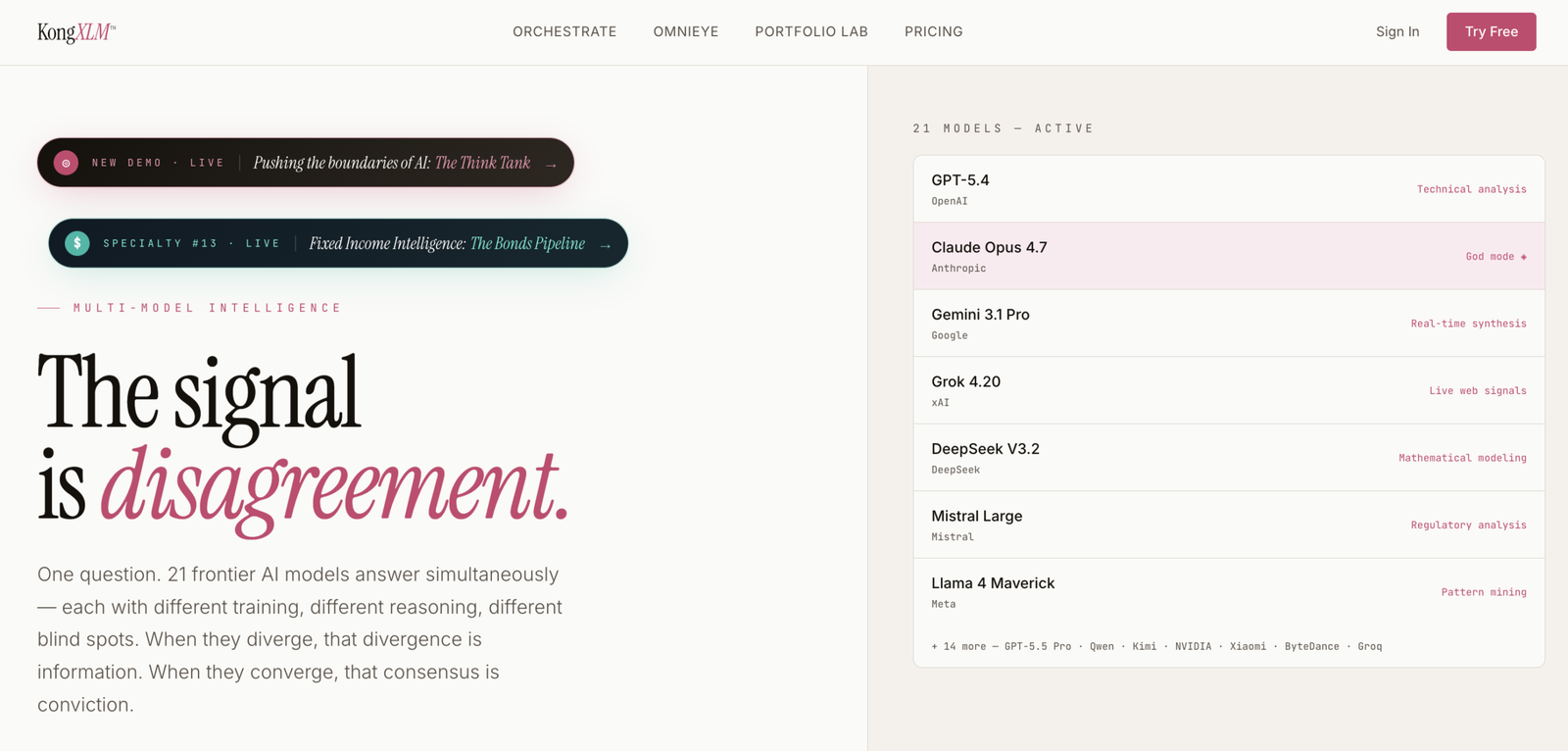
The latest KongXLM update introduces what the company calls a unified intelligence ecosystem: a platform that combines 21 leading frontier AI models into a single, coherent workflow designed for high-level decision-making, research, and forecasting. Rather than asking users to choose one model and hope for the best, the platform is engineered to deploy multiple models simultaneously, synthesize their outputs, and deliver conclusions with measurable confidence.
The architecture is built around three core intelligence systems: Orchestrate, OMNiEYE, and Think Tank. Each serves a distinct function. Together, they represent what KongXLM calls collective intelligence — a new category of AI workflow where the intelligence of many models is more reliable, more nuanced, and more actionable than the output of any single system.
This framing matters. Collective intelligence is not a marketing phrase. It is a well-established concept in decision science, forecasting research, and organizational psychology. The core idea — that aggregating independent judgments from multiple sources outperforms any single expert under most conditions — has been validated across decades of research in fields ranging from economics to epidemiology. KongXLM is applying that principle to AI at scale, and the implications for how organizations use AI are profound.
Orchestrate: One Prompt, Twenty-One Perspectives
KongXLM Orchestrate is the foundational layer of the new platform, and in many ways the most immediately practical. The premise is elegant in its simplicity: you write one prompt, and Orchestrate distributes it simultaneously across multiple frontier AI models. Responses come back side-by-side in a single clean interface, allowing you to compare reasoning, approaches, and conclusions without ever leaving the platform.
The models included in Orchestrate span the full breadth of the current frontier: GPT, Claude, Gemini, Grok, Llama, Mistral, DeepSeek, Qwen, and more — 21 models in total, covering the major architectures, training philosophies, and specialty domains that define the current AI landscape. The platform intelligently classifies incoming prompts and routes them toward the most relevant models based on domain expertise, so a legal research question is not being handled by the same configuration as a Python debugging task.
What Orchestrate delivers is not just speed — though the time savings of eliminating manual cross-platform comparison are significant. What it delivers is breadth of perspective in a form that was previously only available to teams with substantial AI infrastructure budgets. When you send a strategic question through Orchestrate and see GPT, Claude, and Gemini each reason through it from different angles, you are not just getting three answers. You are getting a map of the decision space, a view of where the models agree (which tends to correlate with well-established facts and logic) and where they diverge (which tends to correlate with genuine uncertainty, contested assumptions, or domain-specific nuance).
For financial analysts evaluating a potential investment, that divergence is information. For legal teams assessing the merits of a case, it is information. For product strategists planning a roadmap, for engineers choosing an architecture, for executives making a hiring decision — in virtually any domain where the stakes are high enough to warrant careful thinking, seeing where AI models disagree is often as valuable as seeing where they agree.
Orchestrate is designed to surface both. It is the starting point for a new kind of AI-assisted reasoning — one where the first question is not “what does AI think?” but “where does AI converge, and where does it diverge, and what does that tell me about this decision?”
OMNiEYE: The Oracle at KongXLM
If Orchestrate represents the broadening of AI perspective, OMNiEYE represents a fundamentally different category of AI capability altogether. This is not a comparison engine. It is a prediction and forecasting system — and one of the most technically ambitious AI applications to reach a general business audience.
OMNiEYE is powered by 390 specialized AI agents. These agents do not simply process a query and return an answer. They are designed to analyze information independently, challenge each other’s conclusions, debate assumptions, surface contradictions, and build what the platform describes as a probabilistic consensus through layered reasoning. The output is not an opinion. It is a probability-weighted forecast with measurable confidence scoring.
To appreciate what this means in practice, consider the gap between how a typical AI model handles a forecasting question and how a rigorous analytical process should work. Ask most AI models whether inflation is likely to rise in the next six months, and you will get an answer that sounds confident, draws on training data, and may or may not account for recent developments, conflicting economic signals, or the genuine uncertainty that any honest economist would acknowledge. The answer is shaped by a single model’s training and architecture — a single perspective dressed up in confident prose.
OMNiEYE approaches the same question differently. Its 390 agents process the question from multiple angles simultaneously. Some focus on macroeconomic indicators. Others analyze Federal Reserve communications and policy signals. Others look at commodity prices, labor market data, consumer sentiment, supply chain conditions, and market expectations as priced into financial instruments. The agents do not simply aggregate these inputs — they debate them. Agents that reach different conclusions about what the data implies are designed to challenge each other, forcing the system to either resolve the contradiction through deeper analysis or surface it explicitly as an area of genuine uncertainty.
The data streams feeding this process are live and continuous. OMNiEYE processes real-time information including financial markets, SEC filings, Federal Reserve communications, economic indicators, news signals, market sentiment, and external research feeds. This is not a static knowledge base. It is a continuously updated intelligence environment designed to reflect the world as it is, not as it was when a model was last trained.
The result is a forecasting system that is qualitatively different from anything that single-model AI can produce. Where a single model gives you a response, OMNiEYE gives you a probability distribution. Where a single model sounds confident, OMNiEYE tells you what confidence is actually warranted. Where a single model might miss an emerging signal buried in a regulatory filing or an obscure economic dataset, OMNiEYE’s continuous processing of live data streams is designed to surface it.
For investors, this is the difference between an AI that summarizes what it knows and an AI that tells you what the evidence suggests about what is going to happen — with appropriate uncertainty attached. For hedge funds, family offices, and institutional asset managers who have spent years building proprietary research infrastructure, OMNiEYE represents access to a capability that was previously out of reach for most organizations. For enterprise strategists and policy analysts, it represents a new standard for what AI-assisted decision support can look like.
OMNiEYE is not conversational AI with a forecasting label. It is a purpose-built prediction engine that happens to be accessible through one of the most capable AI platforms available. That distinction matters enormously for anyone who has been frustrated by the gap between what AI promises and what it actually delivers when the stakes are high.
Think Tank: Research That Challenges Itself
The third pillar of the new KongXLM architecture is Think Tank — a multi-model research and verification system designed to address one of the most persistent problems in AI-assisted knowledge work: the tendency of AI to sound authoritative while being wrong.
AI hallucination — the phenomenon where models confidently assert information that is inaccurate, fabricated, or misleading — is not a fringe problem. It is a structural feature of how large language models work, and it has been documented across every major model family. For casual use cases, hallucination is an annoyance. For enterprise use cases involving legal documents, financial analysis, scientific research, or regulatory compliance, it is a liability.
Most AI platforms address hallucination through retrieval-augmented generation, citation systems, or fine-tuning on high-quality data. These approaches help. None of them eliminate the problem. And crucially, none of them give users a reliable signal about when a given piece of AI-generated content should be trusted and when it should be verified.
Think Tank takes a different approach. Rather than trying to make any single model less likely to hallucinate, it deploys multiple AI models to review the same information simultaneously. Each model independently analyzes the datasets, sources, filings, reports, and research documents relevant to a query. The models then participate in a structured synthesis process designed to reduce the errors that emerge when any single system operates in isolation.
The verification architecture includes multiple layers: fact checking, contradiction detection, source mapping, bias reduction, confidence scoring, and consensus validation. These are not sequential steps in a linear pipeline — they are parallel processes that operate across multiple models simultaneously, with the synthesis layer designed to surface disagreements and force resolution before a conclusion is delivered to the user.
What users receive from Think Tank is not a single AI-generated answer. It is a synthesized conclusion built from multiple independent AI perspectives, with the verification process made transparent through confidence scoring and source attribution. When the models agree, users get a high-confidence finding. When they disagree, users get a clear signal that the question involves genuine uncertainty — which is itself actionable intelligence.
For enterprise research teams, this changes the fundamental economics of AI-assisted research. The time currently spent verifying AI outputs against primary sources, cross-checking claims across multiple models, and manually synthesizing conclusions from disparate AI responses — all of that work is what Think Tank is designed to absorb. The output is more reliable. The process is faster. And the audit trail built into the verification architecture provides the kind of documentation that enterprise risk and compliance functions increasingly require.
For investors conducting due diligence on potential acquisitions, for legal teams reviewing complex contractual documents, for analysts building industry reports, for policy researchers synthesizing evidence across large bodies of literature — Think Tank represents a research capability that simply did not exist in a single platform before this update.
Who This Platform Is Built For
KongXLM is explicit about its intended audience: this is not a consumer chatbot. It is a platform built for high-stakes decision-making environments where accuracy, context, and multi-perspective analysis are not optional features but essential requirements.
The sectors where the new KongXLM architecture delivers the most immediate value are those where the cost of bad information is highest.
Investors and hedge funds operate in an environment where information asymmetry is the product and where the difference between a well-calibrated probability estimate and a confident-sounding guess can be the difference between alpha and loss. OMNiEYE’s continuous processing of financial markets, regulatory filings, and economic data — combined with its structured disagreement architecture and probability-weighted outputs — speaks directly to what sophisticated investors have been trying to build internally for years.
Enterprise research teams face the challenge of producing high-quality analysis faster and more reliably than their competitors. Think Tank’s multi-model verification architecture reduces the time spent fact-checking and cross-referencing while increasing the confidence that can be placed in the outputs. For teams producing market intelligence, competitive analysis, or strategic research, this is a material productivity advantage.
Legal professionals work with documents that demand precision. A single misread clause, a single missed precedent, a single incorrect factual claim in a brief or opinion can have serious consequences. Think Tank’s contradiction detection and source mapping capabilities are designed for exactly this kind of work — environments where the standard is not “good enough” but “correct.”
Financial institutions face a dual challenge: they need the speed that AI can provide, and they need the auditability that regulators require. The confidence scoring and consensus validation built into both OMNiEYE and Think Tank provide the kind of documented reasoning trail that risk management and compliance functions need to feel comfortable with AI-assisted analysis.
Technology companies building on or competing with AI need to understand the landscape of current frontier model capabilities more accurately than the marketing materials of any single vendor can provide. Orchestrate gives technical teams a direct, comparative view of how different models handle the same problem — which is more useful than any benchmark for understanding where each model excels and where it struggles.
Government and policy research organizations are under increasing pressure to incorporate AI into evidence synthesis and policy analysis while maintaining the rigor that public accountability demands. The multi-model verification architecture of Think Tank, combined with the transparent confidence scoring, addresses that challenge more directly than any single-model AI tool can.
Collective Intelligence as a Design Principle
The deeper significance of this KongXLM update is what it says about the direction of AI platform development — and why the collective intelligence framing represents more than a product positioning choice.
The history of AI deployment in high-stakes environments has been characterized by a tension between capability and reliability. Models get more capable, but users get more uncertain about when to trust them. Benchmarks improve, but real-world performance in domain-specific applications remains frustratingly inconsistent. The response to this tension has generally been to build better single models — to invest in more training data, more parameters, better fine-tuning, stronger reinforcement learning from human feedback.
KongXLM’s architecture represents a different response: instead of trying to make one model that is reliable across all domains, build an orchestration layer that combines the specialized strengths of many models into a system that is more reliable than any of its components. This is a fundamentally different design philosophy, and it has deep roots in how high-reliability systems are built outside of AI — in aviation, nuclear power, financial risk management, and intelligence analysis.
In each of those domains, the lesson learned over decades is that single-point-of-failure systems are inherently fragile, and that reliability comes from redundancy, independent verification, and structured processes for surfacing and resolving disagreement. OMNiEYE’s 390 agents that debate each other before reaching a consensus, Think Tank’s multi-model verification that forces contradiction detection, Orchestrate’s side-by-side comparison that makes model disagreement visible — these are all expressions of the same design principle applied to AI.
What makes this moment significant is that the frontier models are now capable enough that orchestrating them intelligently produces qualitatively better outputs than any single model can achieve. A year ago, the gap between models was wide enough that the best single model often outperformed any naive combination of others. Today, the frontier has converged enough that the gains from intelligent orchestration exceed the gains from any single model’s marginal improvements. KongXLM is building at exactly the right inflection point.
The Competitive Context
It is worth situating the KongXLM update in the context of the broader AI platform landscape, because the scale of what this architecture represents becomes clearer when you consider what else is available.
Most AI platforms today are either single-model interfaces — the consumer products built by OpenAI, Anthropic, Google, and others — or aggregators that allow users to switch between models without providing meaningful synthesis. The aggregator category has grown rapidly, but the dominant products in this space are still largely doing what KongXLM’s Orchestrate does at a basic level: putting multiple models in one interface. The OMNiEYE forecasting architecture and the Think Tank verification system represent capabilities that go substantially beyond what any current aggregator offers.
On the enterprise side, the most sophisticated AI deployments today involve custom architectures built by teams at major financial institutions and technology companies — internal systems that combine multiple models, build verification pipelines, and layer in proprietary data feeds. These systems cost millions of dollars to build and maintain, require dedicated AI engineering teams to operate, and are inaccessible to the vast majority of organizations that need them. KongXLM’s platform is designed to deliver a version of that capability through a product that does not require building anything from scratch.
This is not a small thing. The democratization of sophisticated AI infrastructure — the transition from “only the biggest players can access this” to “any serious organization can access this” — is one of the most consequential dynamics in enterprise technology. KongXLM is positioning itself at the center of that transition with an architecture that is genuinely more ambitious than what any comparable product currently offers.
What 21 Models Working Together Actually Means
The headline number — 21 AI models — is worth unpacking, because the value is not in the count. It is in the combination.
Different frontier AI models have measurably different strengths. This is not a matter of one model being better than another in an absolute sense — it is a matter of each model having been trained and optimized in ways that produce characteristic patterns of strength and weakness. GPT-4 and its successors have broad capability across domains with particularly strong performance on creative and generalist tasks. Claude has demonstrated exceptional performance on tasks requiring careful reasoning and nuanced textual analysis. Gemini has strong multimodal capabilities and factual retrieval from recent sources. Grok has access to real-time information that other models lack. DeepSeek and Qwen have demonstrated remarkable performance on mathematical and coding tasks.
When you combine these models in an intelligent orchestration system, the combination is more than the sum of its parts in specific, measurable ways. For a query that involves recent financial data, Grok’s real-time access matters. For a query that involves careful legal reasoning, Claude’s analytical depth matters. For a query that involves code generation or mathematical proof, DeepSeek or Qwen’s specialized training matters. An orchestration system that classifies queries and routes them intelligently — as Orchestrate does — captures these specialization advantages systematically rather than requiring users to know which model to use for which task.
And when those models’ outputs feed into a structured synthesis process like OMNiEYE or Think Tank, the disagreements between models become signal rather than noise. The places where GPT and Claude and Gemini all agree are likely to be places where the underlying facts or logic are well-established. The places where they diverge are likely to be places where genuine uncertainty exists, where the evidence is genuinely mixed, or where the question touches on areas where different training approaches produce systematically different judgments. Surfacing that divergence — making it visible and interpretable rather than hiding it behind a single confident response — is what transforms a collection of models into a genuine intelligence platform.
The Future of AI Is Not a Single Model
There is a narrative that has dominated discussions of AI progress for the past several years: the narrative of the frontier model. Each major release — GPT-4, Claude 3, Gemini Ultra, the next version of each — is framed as a step toward an AI system that will eventually be capable enough to handle any task reliably. The implicit promise is that eventually, one model will be good enough at everything that the question of which model to use will become irrelevant.
That narrative has shaped enormous amounts of investment, research, and product development. It has also been wrong, or at least incomplete, in ways that the KongXLM architecture is designed to address.
The reality is that as frontier models have become more capable, their differences have become more interesting, not less. The architectural choices that make one model excellent at careful reasoning make it different, not superior in all dimensions, from a model optimized for breadth and speed. The training decisions that give one model strong performance on mathematical benchmarks shape its behavior in ways that affect its performance on ambiguous, open-ended analytical tasks. Diversity among frontier models is a feature, not a bug — but only if you have an architecture that can capture that diversity and turn it into useful intelligence.
That is what KongXLM’s collective intelligence architecture is designed to do. Not to pick the best model and use it exclusively. Not to average across models in a way that loses the signal from each. But to deploy models in parallel, surface their agreements and disagreements intelligently, and synthesize their outputs through structured processes that add reliability rather than averaging it away.
The future of AI, as KongXLM is building it, is not a single model that does everything well. It is an orchestrated system where the collective intelligence of many models — each contributing its specialized strengths, each checked by the others — produces outputs that no single model can match. This is a vision of AI that is more ambitious than the single-model narrative, more technically demanding to execute, and more consistent with what we know from decades of research about how reliable intelligence systems are actually built.
Getting Started With KongXLM
The new KongXLM architecture — Orchestrate, OMNiEYE, and Think Tank — is available now through the KongXLM platform. The platform is designed for teams and organizations that need more from their AI infrastructure than any single model can provide: more reliable research, more calibrated forecasting, more transparent reasoning, and more confidence in the outputs they use to make decisions.
For investors, analysts, legal professionals, and enterprise research teams who have been waiting for an AI platform that matches the sophistication of the problems they are trying to solve, this update represents a material change in what is possible. The infrastructure that sophisticated organizations have been building internally — at significant cost and complexity — is now accessible through a single platform.
The gap between what AI promises and what it actually delivers in high-stakes environments has been one of the defining frustrations of the current era of enterprise AI adoption. KongXLM’s OMNiEYE update is the most serious attempt yet to close that gap — not by building a better single model, but by building a better system. One that is smarter than any of its parts, more reliable than any single perspective, and designed from the ground up for the environments where the stakes of getting it right actually matter.
21 AI models. One platform. Infinite intelligence.
The future of AI is collective. KongXLM is building it now.